
AI Phone vs Normal Phone: What's the Difference?
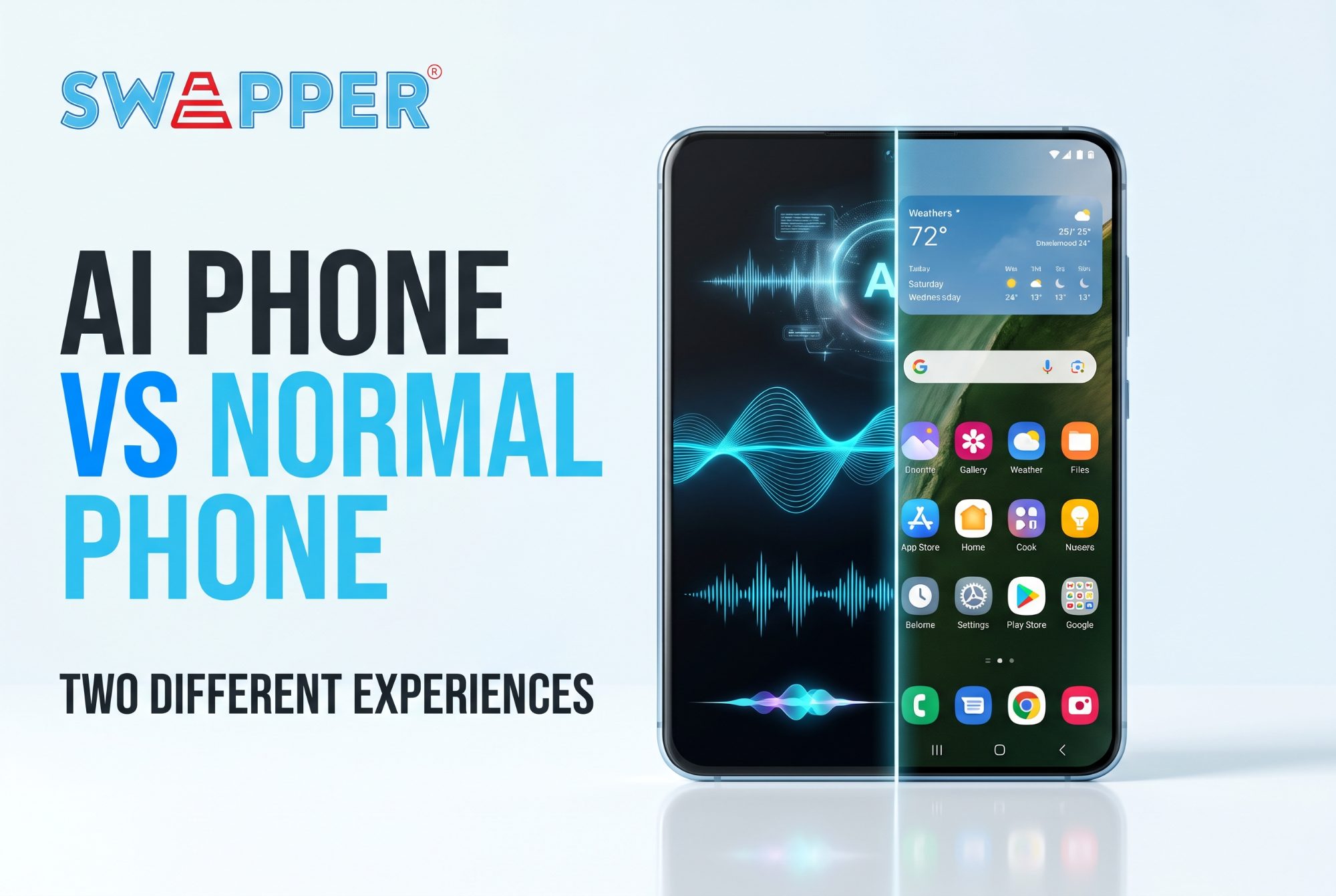
AI Phone vs Normal Phone: What's the Difference?
An AI phone vs normal phone comparison comes down to how each device processes information and helps users complete everyday tasks. An AI phone uses advanced artificial intelligence, including generative AI and machine learning, to understand requests, generate content, automate tasks and provide personalised assistance. A normal smartphone focuses more on traditional functions, although many already use basic AI technology for photography, voice recognition and security.
| Feature | AI Phone | Normal Phone |
|---|---|---|
| Processing | AI-optimised chipset and NPU | Standard smartphone processing |
| AI Assistant | Advanced conversational AI | Basic voice assistant or limited AI |
| Camera | AI-powered editing and enhancement | Standard computational photography |
| Productivity | Summarisation, translation and content generation | Mostly manual tasks and basic automation |
| Connectivity | On-device and cloud AI | Primarily conventional apps and cloud services |
| Price | Varies by model and capabilities | Available across different price ranges |
1. What Is an AI Phone?
An AI phone is a smartphone designed to support advanced artificial intelligence features through specialised hardware and software.
It uses technologies such as machine learning, deep learning and generative AI to understand user behaviour, process information and perform tasks more intelligently.
For example, an AI phone can summarise long documents, translate conversations, generate images, rewrite messages and provide contextual recommendations.
Some devices also feature a Neural Processing Unit (NPU), which accelerates AI-related workloads directly on the phone.
What Can an AI Phone Actually Do?
Select a feature below to explore how artificial intelligence can simplify everyday smartphone tasks.
Document Summary
Turn lengthy documents into shorter summaries to understand important information faster.
Three key updates: project progress, budget status and upcoming deadlines. Review the assigned tasks before the next meeting.
What Is a Neural Processing Unit (NPU)?
An NPU is a specialised processor designed to accelerate artificial intelligence and machine learning operations. It helps compatible smartphones perform certain AI tasks more efficiently without relying entirely on cloud-based processing.
2. What Is a Normal Phone?
A normal phone is a traditional smartphone designed primarily for communication, entertainment, photography, browsing and running mobile applications.
It relies on its CPU, GPU, memory and software to perform everyday operations.
However, a normal smartphone is not necessarily free from AI. Features such as facial recognition, automatic scene detection, predictive text and noise reduction already use machine learning.
The main difference is the level of AI integration, processing capability and availability of advanced generative AI features.
How Smart Is Your Normal Phone?
Select the features available on your smartphone. Discover how traditional smartphone functions already use AI technology.
Select the features available on your phone to discover how machine learning and other AI technologies are already part of everyday smartphones.
Whether you are looking for a traditional smartphone or exploring newer AI-powered devices, choosing the right model starts with understanding your everyday needs. Explore the latest smartphone options at Swapper Malaysia to compare devices and find a smartphone that suits your requirements.
3. Key Differences Between AI Phone and Normal Phone
The biggest differences become clearer when comparing how both devices handle everyday activities.
AI Assistants and Generative AI
AI phones can offer conversational AI assistants that understand natural language and respond to more complex requests. Some can summarise information, generate content and interact with supported applications.
Normal phones may offer basic voice commands but typically have fewer integrated generative AI capabilities.
Camera and Image Processing
Both smartphones can use AI for photography. However, advanced AI phones may offer additional features such as generative image editing, object removal, photo enhancement and intelligent scene adjustments.
Performance and Processing
AI phones may include specialised NPUs and optimised chipsets to run machine learning models efficiently.
Some AI tasks run directly on the device, while others require cloud processing and an internet connection.
4. On-Device AI vs Cloud AI: How Does It Work?
Not all AI features work the same way. The main difference is where the processing takes place: directly on your smartphone or through remote servers.
On-device AI processes information directly using the smartphone's hardware. It can offer faster responses, improved offline availability and greater control over personal data.
Cloud AI sends requests to remote servers for processing. This allows smartphones to access more powerful AI models, although internet connectivity may be required.
Some smartphones combine both approaches depending on the feature and the complexity of the task.
On-Device AI vs Cloud AI: Key Differences
On-Device AI
Processes supported AI tasks directly on the smartphone. It can reduce reliance on internet access and limit the need to send data to external servers.
Cloud AI
Uses remote servers to run AI models. It can provide access to larger models and more demanding processing capabilities, depending on the service.
Hybrid AI
Combines local and cloud processing. A smartphone can handle simpler tasks locally and send more complex requests to remote servers.
Actual AI capabilities and offline availability vary by smartphone model, chipset, software, supported features and region.
Frequently Asked Questions (FAQ)
Find answers to common questions about AI phones, traditional smartphones and their differences.
An AI phone offers more advanced integrated AI capabilities, including generative AI, intelligent assistants and automated tasks. A normal smartphone can also use AI for everyday features, but may have fewer advanced AI tools built into its hardware and software.
Yes. Many normal smartphones already use AI and machine learning for features such as facial recognition, automatic camera adjustments, predictive text and voice recognition. The main difference is the level of AI integration and the availability of more advanced features.
Not always. On-device AI can perform selected tasks directly on a smartphone without internet access. However, cloud-based AI features generally require an internet connection to communicate with remote servers. Offline availability depends on the device, software and specific AI feature.
An AI phone is worth considering if you regularly use AI-powered productivity, creative or communication tools. If you mainly use your smartphone for messaging, social media, streaming and everyday applications, a conventional smartphone may meet your needs without requiring advanced AI features.
AI capabilities vary between smartphone models. Always check the supported features, hardware requirements and regional availability before purchasing.
Conclusion
The AI phone vs normal phone comparison highlights how smartphone technology is evolving beyond traditional communication and entertainment.
AI phones bring more advanced automation, generative AI and intelligent assistance into everyday activities. However, normal smartphones remain practical choices for users who do not need these additional capabilities.
Ultimately, choose a smartphone based on its real-world performance, useful features and long-term value rather than its AI marketing claims.
Get RM200 OFF Your Purchase
Use the voucher code below at checkout when your purchase meets the minimum spend requirement.
Minimum spend: RM2,500. Enter the code at checkout. Voucher terms and eligibility may apply.
Shop PhonesCompare your options carefully and choose a smartphone that delivers the features, performance and value you actually need.